Art Works from Fall Semester 2025
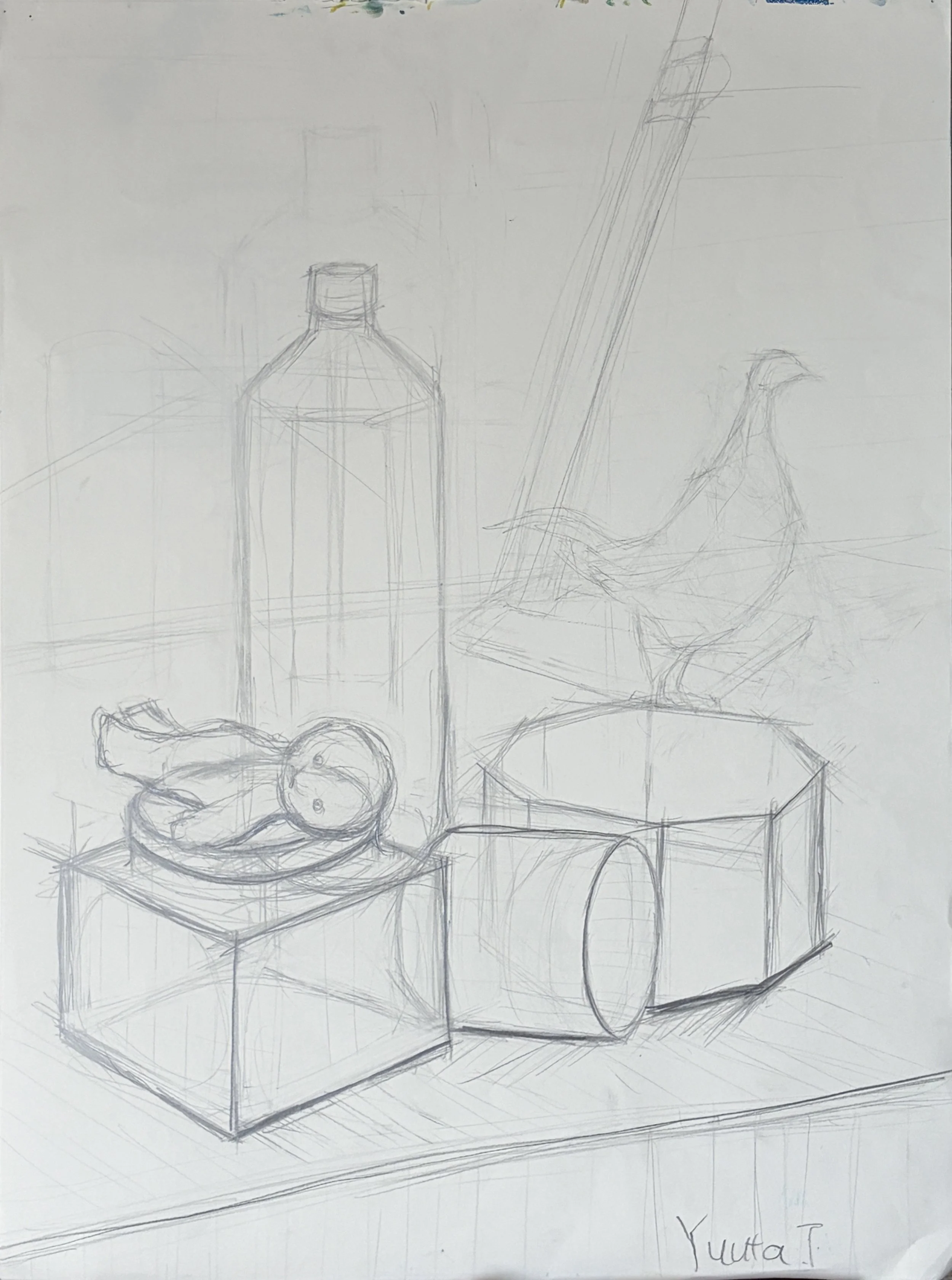
Title: Practice Drawing ----- This drawing focuses on exploring spatial depth and perspective through line. All objects are personal belongings, which I arranged to practice a balance of geometric forms, angles, and rounded volumes. I used variations in line weight to suggest distance, allowing foreground forms to feel heavier and background forms lighter. The cube in the front left functions as the closest anchor point, while a portion of the light stand in the back right establishes the furthest depth. This study helped me become more intentional about organizing space within the picture plane.
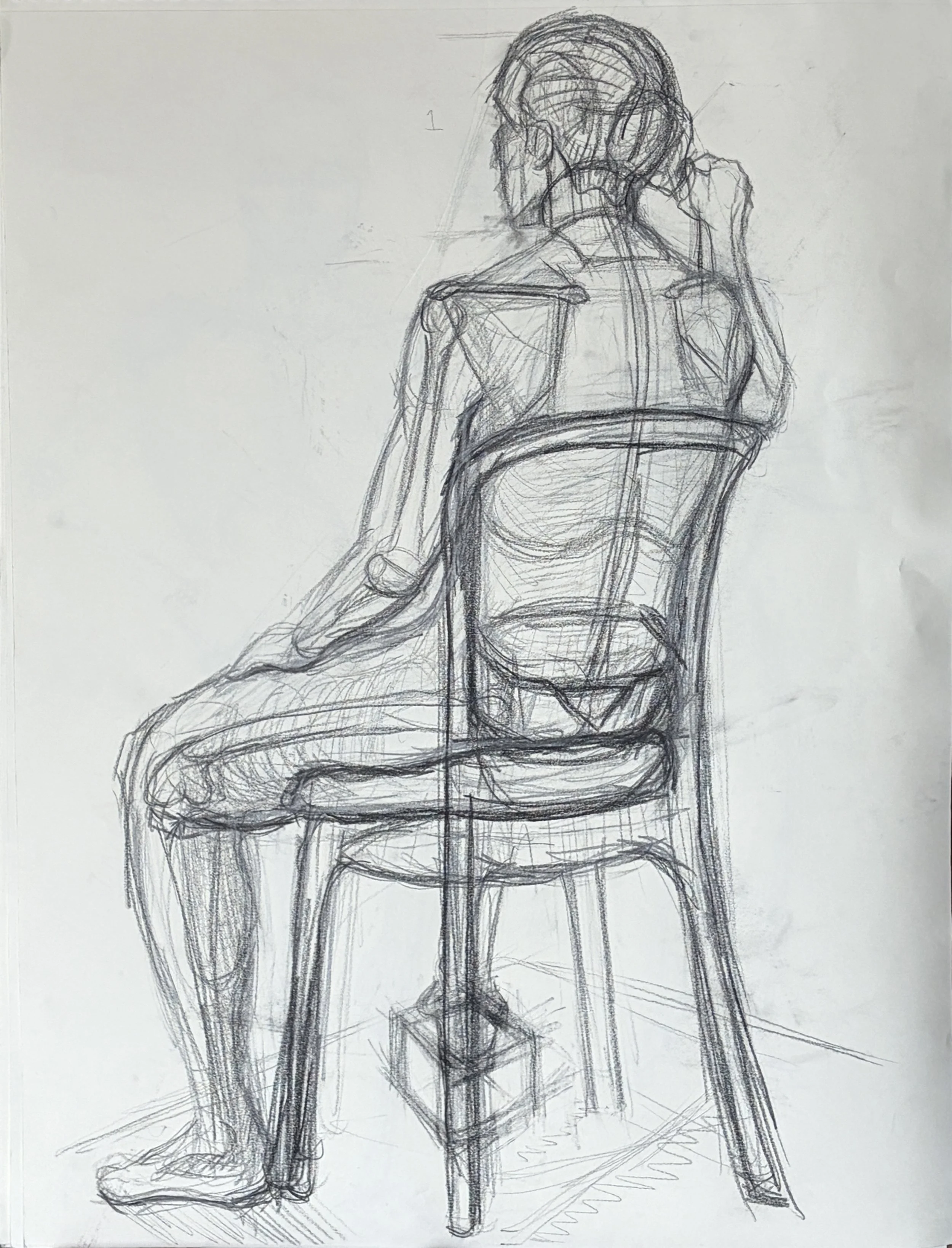
Title: Figure Drawing ---- This is a figure study drawn during class from a live model in their thirties. The model stands with a cube under the right foot and holds a cane in the right hand. The most challenging aspect was capturing the angle and structure of the hand gripping the cane. I focused on maintaining natural balance and underlying skeletal structure, lightly indicating bones beneath the surface. I believe that understanding the skeleton is essential to creating figures that feel grounded and believable. I continue to study anatomy through books and anatomical models, and figure drawing has become a central interest in my practice.
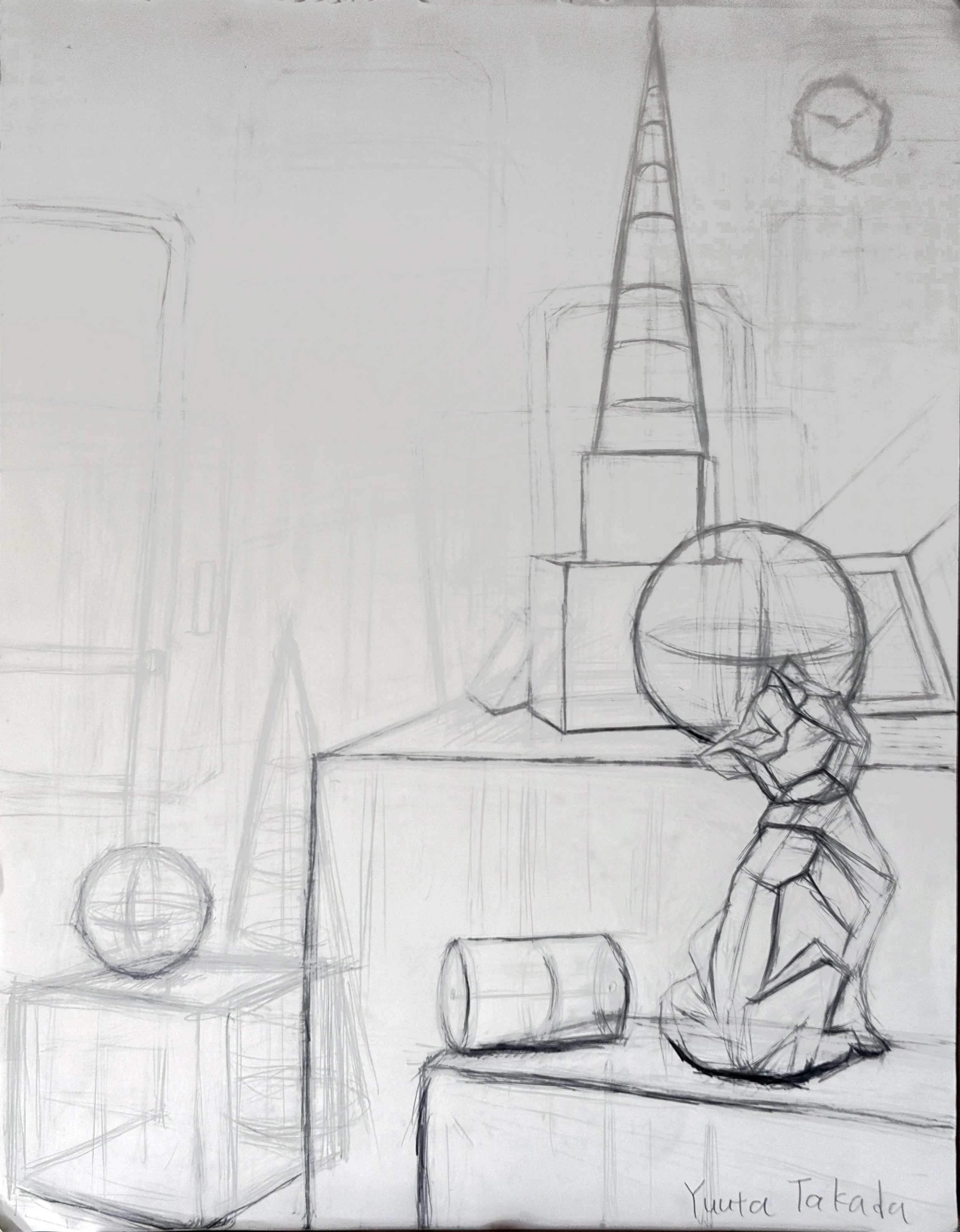
Title: Practice Drawing ---- Unlike the first drawing, which was self-arranged, this work was drawn from a still life prepared by the instructor. The composition included multiple objects with varied heights and positions extending in all directions, making it well suited for studying depth and spatial relationships. I found this drawing process especially engaging. The multifaceted cat object placed in the foreground is a section I am particularly satisfied with, as it allowed me to clearly define complex planes within a solid form.
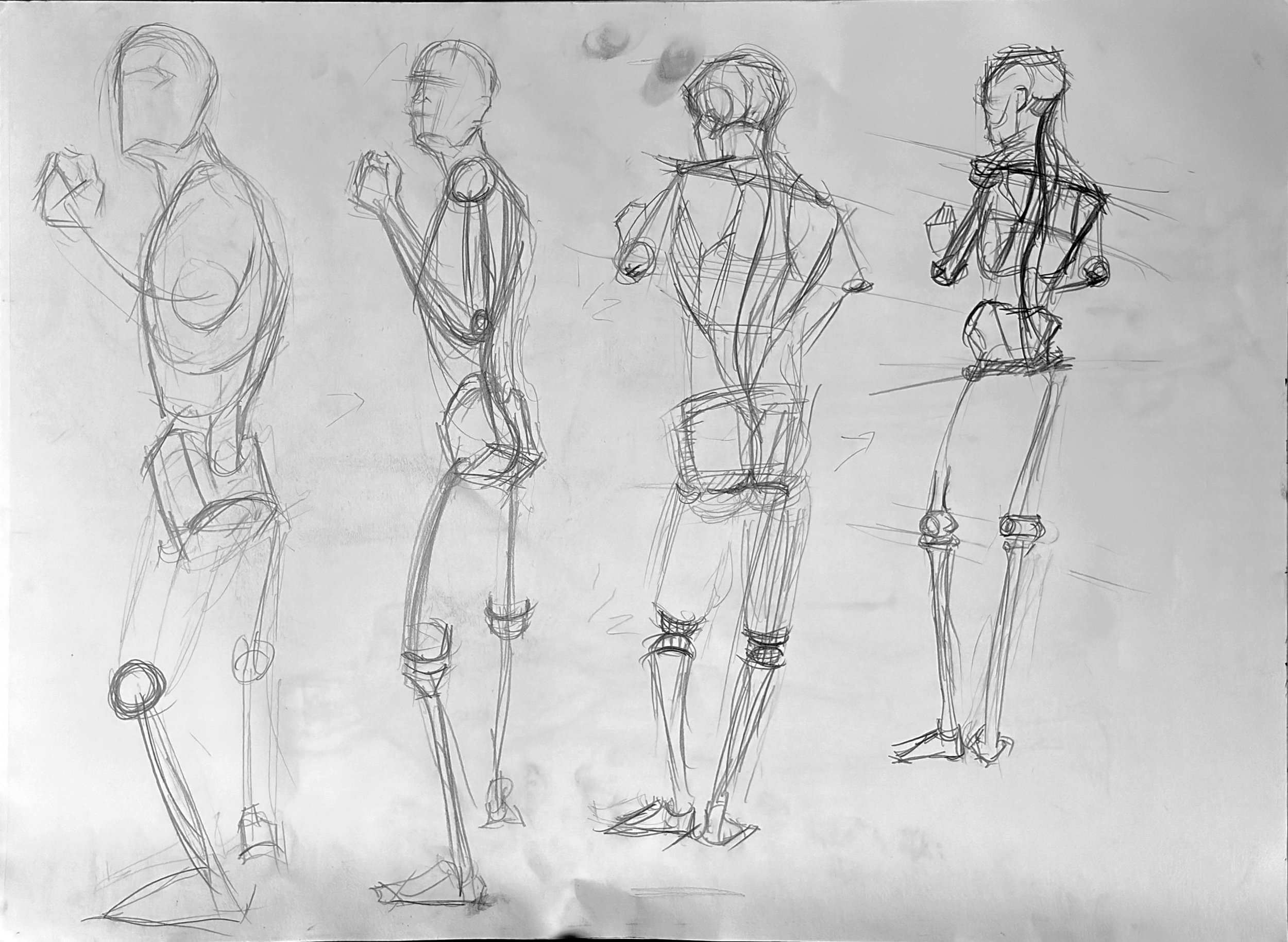
Title: Figure Studies ---- These figure studies were drawn during free time in class as part of my growing interest in the human body. The leftmost figure is reduced to its simplest structure, with the pelvis treated as a basic cube. In contrast, the rightmost figure reflects the pelvic form commonly seen in anatomical models. Among the four figures, the third study is the most successful, as I began to consider skin and muscle in addition to structure. Throughout these studies, I adjusted leg length while evaluating the balance between the upper and lower body. I am currently focusing on improving my understanding of hands and toes through continued practice.